Saturday, 7 September 2013

Seasons 2

The other two statues in this series of four are of course Autumn and Winter.

Three of the four statues are represented by nubile young woman, but in the Winter statue it is represented by an old man. By the looks of that statue it is in need of some TLC because as winter has us cloaked up in coats he has a cloak of green covering him.


                                                                              Autumn

 
Winter
 
The statues have been restored by the carving skills of Polish- born master mason Jacek Luszcyk. They were unveiled in their original positions after restoration in 2010.

Friday, 6 September 2013

Seasons

Throughout the Royal Botanic Gardens there are many wonderful statues that adorn the steps and
paths.
As it is Spring in Sydney at the moment I thought I would start with my two favourites seasons, Spring and Summer.
 These two statues are part of a group of eight statues imported from Italy in 1883 and include Seasons, Boy Extracting Thorn, La Ballarina, Sweep Boy and  a young girl with a scarf, clogs and musical instrument from the Donizetti opera ‘Linda di Chamonix’.  
 
Sir Henry Parkes promoted the use of public sculpture to beautify the colony and for the so-called "uplifting of the lower orders" and used classical statuary in gardens to educate those who could not afford the "grand tour" and see sculpture like this for themselves.


Over time the statues at various times were removed and kept at the gardens in a shed known by staff as the Graveyard, as they had become subject to vandalism, decapitation and deterioration.


Thursday, 5 September 2013

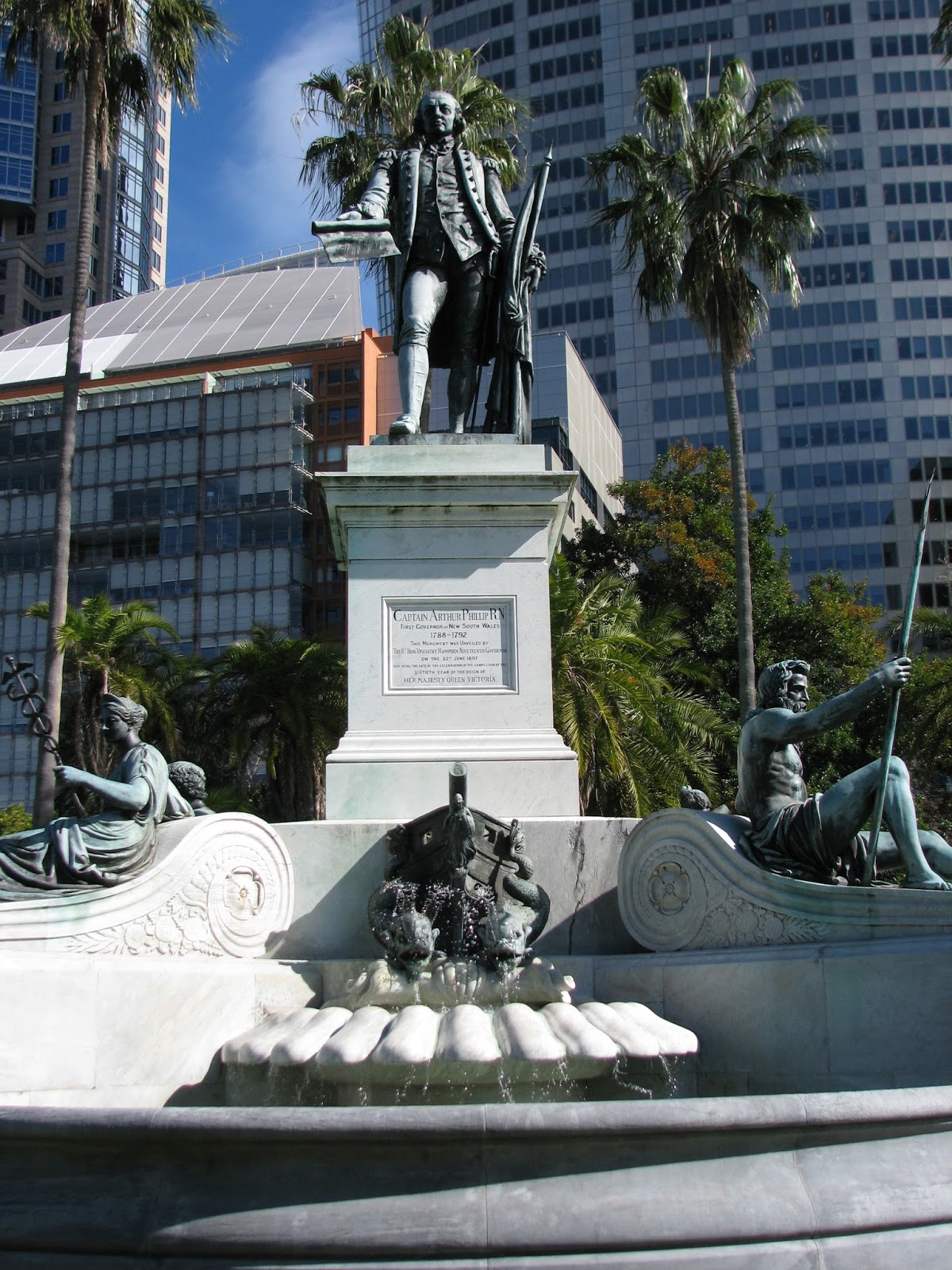
Governor Phillip Fountain


As we continued on our public art walk with Dr Nicholas Hardwick we viewed this spectacular fountain in honour of our first Governor, Captain Arthur Phillip.

The fountain was commissioned by Sir Henry Parkes as part of the 1888 Centennial celebrations but it wasn't finished until nearly a decade later. Originally expected to be completed in 4 years by sculptor Achille Simonetti, it was plagued with issues from interfering politicians, not only changing what it should look like but Governor Dibbs putting a halt to entire project for a year.


It consists of a Carrara marble pedestal upon which a bronze statue of  Governor Phillip stands with  3 relief panels representing Justice, Patriotism and Education.

Around the pedestal are 4 reclining figures made of bronze of Neptune, Cyclops, Agriculture and Commerce. Between these 4 figures are giant clam shells featuring four bronze prows of ships which feed the water into the white marble basins.


                                                                                  Commerce

                 
                                                                      Agriculture

                                                                       Cyclops - representing Mining

                                                              Neptune - representing Navigation

The fountain was unveiled by Lord Hampden on the 22nd June 1897 on the celebration of the 60th year of the reign of Queen Victoria. A truly magnificent tribute to a great man.

Wednesday, 4 September 2013

Garden Palace Gates

The gates to the Royal Botanic Gardens from Macquarie St, known as The Palace Garden Gates, are the only remaining signs of a contentious building that was built to show the world that the colony had come a long way from it's humble beginnings.


The Garden Palace was a purpose built exhibition building in Sydney to house The Sydney International Exhibition in 1879. It was designed by colonial architect James Barnet and built in just 8 months. This was largely due to the importing of electric light from England allowing work to be done 24 hours a day.


After the exhibition was finished the building was used as office space for a number of government departments. It also held the records of the 1881 census, railways surveys and land titles. The building was made of wood and in 1882 fire destroyed the palace along with all it's contents.


Another interesting fact connected to the staging of this International Exhibition was that Aboriginal people were still living on the harbour near where the Museum of Contemporary Art is now and the government didn't think that this presented a good image of Sydney so they encouraged them to move out of the city with many moving to La Perouse where there was a large Aboriginal community.


Friday, 23 August 2013

Hi there

I seem to be having some technical difficulties with uploading photos to the blog at the moment so until I can figure out what is happening, there will be  no new posts for the near future.

Sorry about the interruption but as I said in the intro this is my way of keeping computer savvy so this will test my limited knowledge.

Enjoy your weekend and hope to be back online soon.

Cheers

Kim

Wednesday, 21 August 2013

The Morshead Fountain

The Morshead Fountain was erected in remembrance of Lieutenant-General Sir Leslie Morshead and  the men who served with him in the war of 1914-18 and in the defence of Tobruk Libya in 1941 for which he was knighted.

It is located across from the State Library of NSW at one of the entrance gates to the Royal Botanic Gardens.


The fountain was designed by architects Woodward, Taranto and Wallace. A new fountain head was installed in 1983.
It was unveiled by Lady Morshead in 1966.
Unfortunately the day I photographed the fountain the water wasn't flowing while I was there.

Tuesday, 20 August 2013

Equine Heroes of WWI

The Desert Mounted Corps Memorial is a piece of public art that most people would probably miss, as it is almost hidden, set back into the south west external wall of the Royal Botanic Gardens.


It is a memorial to the 140,000 horses that served in the desert campaign in World War One, only one of which was able to return to Australia. The memorial was erected on Anzac Day 1950 by the friends and members of the Desert Mounted Corps. It was unveiled by Lady Chauvel, whose husband General Sir Harry Chauvel commanded the Desert Mounted Corps.


The memorial consists of  horses with ammunition pouches around their necks and reins held by a trooper in short sleeves, hats and boots, with ammunition pouches across his chest.

Like the Shakespeare Memorial this was also moved to its present location in the mid 1960's due to the construction of the Cahill Expressway.