One of the lesser known explorers and certainly not as famous as many of our others is James Meehan. He came to Australia in 1800 penalised for his part in the Irish rebellion of 1798. After arriving he was assigned as a servant to Charles Grimes, the surveyor general at the time.
While there are no great exploits attributed to his exploration he was instrumental in supporting the surveyor generals and mapping large areas of the colony.
He accompanied Grimes and Francis Barrallier exploring the Hunter River in 1801 and in 1802 -03 exploring King Island and Port Phillip.
When Charles Grimes was on leave James Meehan was the only qualified surveyor in the colony and having been pardoned, did most of the departmental duties during this time. In 1805 he surveyed the track between Prospect and Cowpastures. He also marked out 5000 acres for John Macarthur at Camden Park. At this time he was granted land in the district of Minto and after it was initially withdrawn, in 1810 Governor Macquarie granted him 1140 acres to be known as Macquarie Field.
He was very nearly appointed Surveyor General in 1812 but another one of our famous explorers John Oxley petitioned the British Government tirelessly and Oxley was eventually appointed. Governor Macquarie then appointed Meehan deputy surveyor of lands.
During the following years he measured every farm not only in New South Wales but in Van Diemen's Land also. He accompanied Governor Macquarie on most of his tours of inspection in New South Wales and Van Diemen's Land.
In 1818 Governor Macquarie sent him with Charles Throsby to look for a way from Sutton Forest to the coast at Jervis Bay. From this expedition he left Charles Throsby and where he went downstream, Meehan went upstream following the Shoalhaven gorge and discovered Lake Bathurst and the Goulburn plains.
He made significant contributions to the mapping of the colony, exploring, laying out and measuring Sydney, Parramatta, Bathurst and Port Macquarie and surveying the townships of Richmond, Castlereagh, Windsor, Pitt Town, Wilberforce, Liverpool and Bathurst in New South Wales, as well as Hobart Town in Van Diemen's Land.
In 2010 James Meehan was honoured with inclusion of a statue on the façade of the Department of Lands building on the Loftus Street side. Made from Appin sandstone it was carved at the NSW Public Works stone yard.
Interesting fact - being a convict there were no portraits of James therefore the statue is based on a photograph of his son Thomas, with the stonemason hoping that he looked a lot like his father.
This is my way of keeping me computer savvy and help with my transition to retirement in an interesting and enjoyable way.
Wednesday, 16 October 2013
Tuesday, 15 October 2013
Sandstone Explorers
It's been awhile since I last posted and in that time I haven't really expanded my historical photo library much, so I am determined to get back into blogging and photography with renewed interest.
One of my favourite things about Sydney is all of the beautiful sandstone buildings. In the following posts I am going to look at some of these buildings. The first one was designed by James Barnet, colonial architect - The Lands Department Building in Bridge Street. And in particular the explorers and legislators which adorn the façade.
There are 23 in total, too many to post one after the other or even blog about so I am going to choose my top ten and intersperse them with other posts.
This first post is about 2 explorers whose names are synonymous with early exploration of Sydney's waterways and quite often spoken about together - Bass and Flinders
George Bass and Matthew Flinders met as young men on board the HMS Reliance in 1795 on a journey to Sydney and discovered they both shared an interest in navigation and sea exploration. As soon as arriving in the new colony they made plans to explore in a small rowboat called the Tom Thumb, which George Bass had brought with him on the journey.
Both of these explorers had unusual ends to their lives.
George Bass resigned from the Royal Navy and sailed trading vessels until in 1803 he left Sydney Harbour for Chile and neither he nor his boat or crew were ever seen or heard from again.
In 1803 Matthew Flinders sailed for England as a passenger on a ship which was wrecked on a coral reef off the Queensland coast, he took control of the lifeboat and sailed it back to Sydney to get help for his fellow passengers.
He then set sail in a small schooner back to England but it proved unseaworthy and he sailed to Mauritius seeking help but unknown to him at that time England and France were at war and they arrested him as a spy and kept him in gaol on the island for 6 years.
He eventually returned to England in 1810 and in poor health died just 4 years later in 1814
Both of these men had a great influence on the exploration of the Australian coastline as we know it today.
One of my favourite things about Sydney is all of the beautiful sandstone buildings. In the following posts I am going to look at some of these buildings. The first one was designed by James Barnet, colonial architect - The Lands Department Building in Bridge Street. And in particular the explorers and legislators which adorn the façade.
There are 23 in total, too many to post one after the other or even blog about so I am going to choose my top ten and intersperse them with other posts.
This first post is about 2 explorers whose names are synonymous with early exploration of Sydney's waterways and quite often spoken about together - Bass and Flinders
George Bass and Matthew Flinders met as young men on board the HMS Reliance in 1795 on a journey to Sydney and discovered they both shared an interest in navigation and sea exploration. As soon as arriving in the new colony they made plans to explore in a small rowboat called the Tom Thumb, which George Bass had brought with him on the journey.
Their first exploration took them south to Botany Bay where they explored the Georges River (named in honour of King George III) which led to establishment of the settlement of Bankstown. Incidentally this is the area in which I live.
On their second journey they discovered and named Port Hacking and Lake Illawarra.
Both Bass and Flinders, having also explored separately were convinced there was a body of water between mainland Australia and Van Diemen's Land and in 1798 they rowed along the northern coast of Van Diemen's Land, and rowed up the Tamar River near where Launceston stands today. While there they climbed Mount Wellington which overlooks Hobart. They proved that there was water between Australia and Van Dieman's Land and it was named Bass Strait by Governor Hunter.
George Bass resigned from the Royal Navy and sailed trading vessels until in 1803 he left Sydney Harbour for Chile and neither he nor his boat or crew were ever seen or heard from again.
In 1803 Matthew Flinders sailed for England as a passenger on a ship which was wrecked on a coral reef off the Queensland coast, he took control of the lifeboat and sailed it back to Sydney to get help for his fellow passengers.
He then set sail in a small schooner back to England but it proved unseaworthy and he sailed to Mauritius seeking help but unknown to him at that time England and France were at war and they arrested him as a spy and kept him in gaol on the island for 6 years.
He eventually returned to England in 1810 and in poor health died just 4 years later in 1814
Both of these men had a great influence on the exploration of the Australian coastline as we know it today.
Wednesday, 18 September 2013
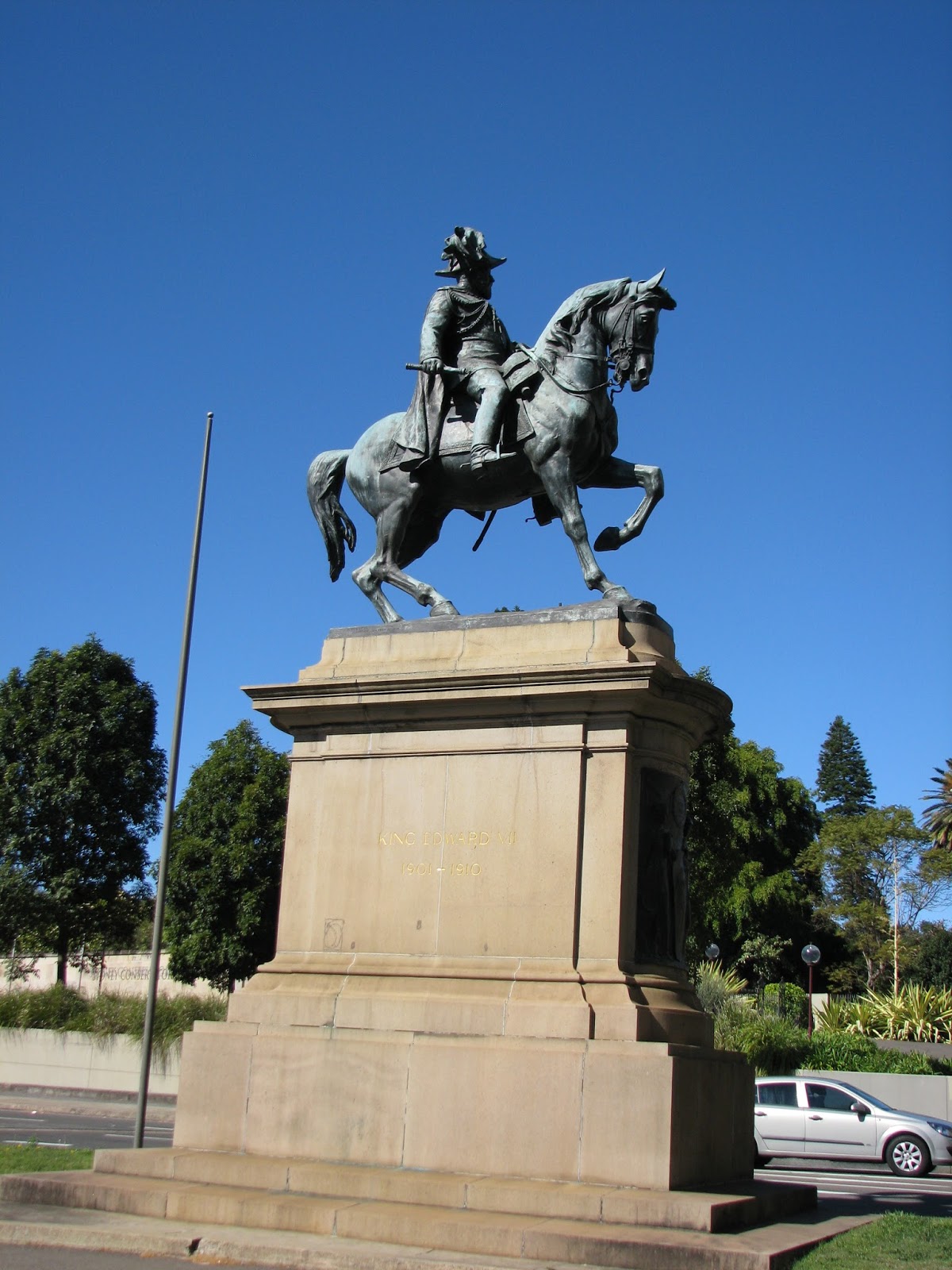
King Edward VII Statue
The statue of King Edward VII is an impressive bronze sculpture which stands outside the Conservatorium of Music on Conservatorium Road looking down Bridge Street.
Three different views of King Edward VII.
When we took part in the Public Art walk with Dr Nicholas Hardwick we were given an information sheet about the art that we viewed. In this information the sculptor of the Sydney statue is Sir Thomas Brock and it was completed in 1922.
But when researching more information about the statue on another site it has been attributed to Sir Edgar Bertram Mackennel. On further investigation this statue can be found in Melbourne Queen Victoria Gardens and was completed in 1920, two years before the Sydney one. Perhaps more evidence of the rivalry between these two cities.
Interesting trivia, Sir Thomas Brock is best known for his public monuments and statuary in London, especially the Victoria Memorial in Buckingham Palace.
Monday, 16 September 2013
"A Palace for Horses" - Conservatorium of Music
As we approached the end of our public art walk we viewed the building that was originally designed to be the stables for the new Government House that Governor Macquarie had planned to build in the Government Domain. It is the Conservatorium of Music formally the Government Stables.
In 1816 Governor Macquarie commissioned Francis Greenway to design an impressive residence and stables in the castellated style.
Due to his penchant for building and what was termed his extravagance in his term of office Governor Macquarie's vision was only partially completed, that being the stables we see now.
View from the Old Mill Garden in the Royal Botanic Gardens.
The positioning of the stables at the time determined the style and site of the second Government House.
In recent times the Governor of NSW has again taken residence in Government House.
In 1816 Governor Macquarie commissioned Francis Greenway to design an impressive residence and stables in the castellated style.
Due to his penchant for building and what was termed his extravagance in his term of office Governor Macquarie's vision was only partially completed, that being the stables we see now.
View from the Old Mill Garden in the Royal Botanic Gardens.
The positioning of the stables at the time determined the style and site of the second Government House.
In recent times the Governor of NSW has again taken residence in Government House.
Wednesday, 11 September 2013
Allan Cunningham Obelisk
The next part of our public art walk took us past The Allan Cunningham Obelisk set in a pond near the Botanic Garden Restaurant.
It is in honour of Allan Cunningham who was an explorer and botanist. He worked for sir Joseph Banks in London and travelled with Phillip Parker King on four journeys to survey the Australian coastline. He was also a Superintendent of the Botanic Garden for a short time "resigning when, as a newspaper put it he 'would no longer consent to be a mere cultivator of cabbages and turnips'.
He died in 1839 and was buried in the Devonshire Street Cemetery but his remains were moved in 1901 to the memorial obelisk above. His tombstone is mounted on the wall of the National Herbarium of NSW.
The plants in the garden beds around the obelisk pond are examples of plants collected by Allan Cunningham from the Illawarra between 1818 and 1822.
This monument is difficult to photograph because it is always in shade.
Tuesday, 10 September 2013
Magnolia Seed and Palm
These two sculptures are two of the more modern ones in the Royal Botanic Gardens.
They are a pair of metal structures by Bronwyn Oliver in two locations placed under a magnolia and a palm tree representing the site of the First Farm in Sydney Cove. This area of the Gardens was originally a mud flat that had any manner of organic debris washed up onto the shore which could take root and grow. These sculptures symbolise "the potential for transformation and new life" (taken from the plaque beside the sculpture).
Magnolia Seed
They are a pair of metal structures by Bronwyn Oliver in two locations placed under a magnolia and a palm tree representing the site of the First Farm in Sydney Cove. This area of the Gardens was originally a mud flat that had any manner of organic debris washed up onto the shore which could take root and grow. These sculptures symbolise "the potential for transformation and new life" (taken from the plaque beside the sculpture).
Magnolia Seed
Palm
Another sculpture "Vine" is located in the foyer of the Sydney Hilton. Most Australian galleries have sculptures by this sculptor who passed away in 2006
Labels:
Bronwyn Oliver,
Sculptures
Saturday, 7 September 2013
Seasons 2
The other two statues in this series of four are of course Autumn and Winter.
Three of the four statues are represented by nubile young woman, but in the Winter statue it is represented by an old man. By the looks of that statue it is in need of some TLC because as winter has us cloaked up in coats he has a cloak of green covering him.
Autumn
Three of the four statues are represented by nubile young woman, but in the Winter statue it is represented by an old man. By the looks of that statue it is in need of some TLC because as winter has us cloaked up in coats he has a cloak of green covering him.
Autumn
Winter
The statues have been restored by the carving skills of Polish- born master mason Jacek Luszcyk. They were unveiled in their original positions after restoration in 2010.
Subscribe to:
Posts (Atom)